
How is the recommended commission calculated: breaking down the mechanism clearly
Promoting YuJun is the path with the lowest threshold among the two revenue streams—just post a link to get started. But "being able to start" does not equal "knowing how to calculate". Many people rely on their instincts, resulting in confusion about how much they actually earned, why some amounts weren't counted, and how to level up. In this article, I will thoroughly explain the mechanism; reading it before you start is better than pushing for half a year without understanding.
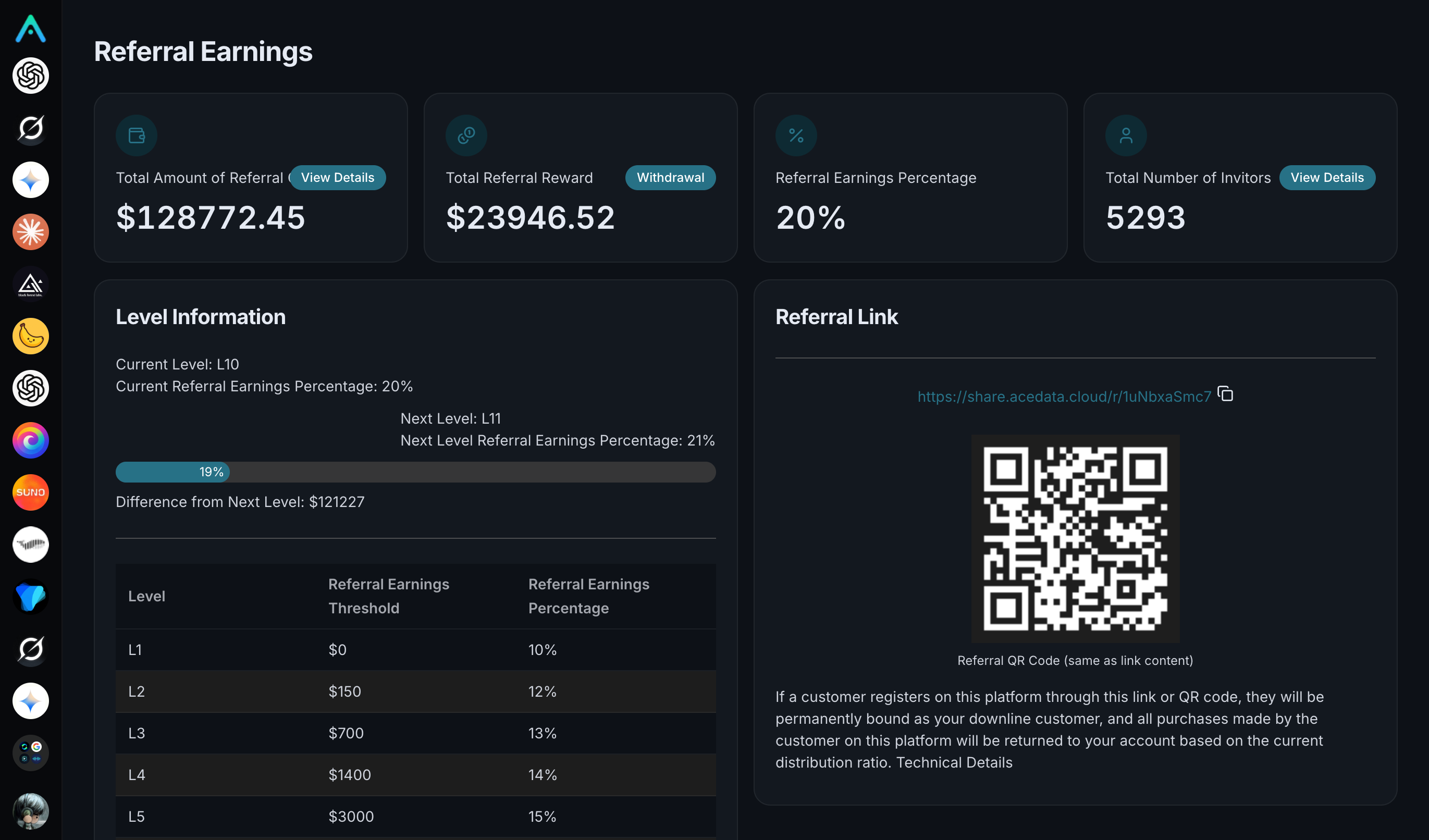
The image above shows the real appearance of the commission backend. We will explain it based on this.
¶ 1. Binding: How customers are "attributed to you"
After you register, you will receive an exclusive promotion link, which looks like this:
https://platform.acedata.cloud/?inviter=<your user ID>
The backend will directly generate this link and the corresponding QR code for you; you can copy and use it. It carries your exclusive identifier.
The complete logic of binding is as follows:
- When someone clicks your link to access the platform, the browser will remember "this person was brought by you"—this memory has a validity period of 7 days (
INVITER_IDcookie, saved for 7 days); - As long as they register within these 7 days, they will be bound as your subordinate;
- Once bound, the relationship is long-term—it’s not "this order counts for you," but "this person will count for you long-term."
Key point: The moment of "registration" determines attribution. If they click your link and register within 7 days, they are bound. So your goal is clear—get people to click the link + get people to register. Whether they buy today or how much they buy does not affect the binding; the binding is long-term, and the money will come gradually later.
¶ 2. Commission: Where the money comes from and how it is calculated
The commission comes from your subordinates' real consumption. Whether they recharge, use AI to generate images and videos, run APIs, or purchase packages—as long as there is real consumption, you will share the profits according to the ratio.
- It’s not "money for bringing people in"—just registering without consumption does not yield commission;
- It’s a consumption share—the more they spend, the more you earn;
- It’s long-term—if they recharge this month, next month, and continue to recharge next year, you will have a share each time.
This is why I always say, "A tutorial written today will help you earn money for a long time"—because you are bringing in a long-term consuming user, not a one-time click.
¶ 3. Level: The more you consume, the higher your ratio (real 13-level ladder)
The level table in the backend image—L1, L2, L3... each level corresponds to a cumulative recommended consumption threshold and a commission ratio. This is the platform's real 13-level ladder (values are based on real-time display in the backend):
| Level | Cumulative Customer Consumption Threshold (USD) | Commission Ratio |
|---|---|---|
| L1 | $0 (starting) | 10% |
| L2 | $150 | 12% |
| L3 | $700 | 13% |
| L4 | $1,400 | 14% |
| L5 | $3,000 | 15% |
| L6 | $7,000 | 16% |
| L7 | $14,000 | 17% |
| L8 | $28,000 | 18% |
| L9 | $50,000 | 19% |
| L10 | $100,000 | 20% |
| L11 | $250,000 | 21% |
| L12 | $500,000 | 22% |
| L13 | $1,000,000 | 24% |
The threshold looks at the cumulative consumption amount of all customers under your name; reaching a certain level will elevate you to that tier, only increasing, not decreasing. The partner in the image has already reached L10 and is climbing towards L11. The logic is simple: the more cumulative consumption you bring in, the higher your level, and the higher the commission ratio for each subsequent share. The efforts made early on will reward you with a higher ratio later.
So don’t underestimate the initial 10%—it will increase. What you need to do is to get the "cumulative recommended consumption" number rolling, and the level will naturally rise, potentially reaching 24%.
¶ 4. Two-level sharing: What if you were invited by someone else
If you registered through someone else's link (you have an "upstream"), then the above ratio will be split 80/20 once:
- You (the direct inviter) receive: ratio × 80%
- Your upstream receives: ratio × 20%
Let’s illustrate the mechanism with an example (this is an algorithm demonstration, not an income promise): you are at L1 (10%), and the customer you brought in spent $100—
- If you have an upstream: you earn
$100 × 10% × 80% = $8, and your upstream earns$100 × 10% × 20% = $2; - If you do not have an upstream (you registered directly): then the 20% does not apply, and you settle at the direct ratio.
The frontend display for "users with upstream" shows the ratio already multiplied by 0.8, which is the amount you actually receive; what you see is what you get, and you don’t need to calculate it yourself.
Want others to help you promote and turn that 20% into your long-term passive income? Check out "Two-Level Distribution: Let Others Help You Make Money."
¶ 5. Under what circumstances commissions are not paid (avoid pitfalls)
I will honestly mention a few situations that "do not count" or "need attention" to prevent you from thinking it counts when it actually does not:
- Only registered, no consumption: No commission. The source of commission is always real consumption.
- Registered after the binding window: If he clicks the link and registers too late (beyond the 7-day validity), the attribution will not be established.
- Abnormal / fraudulent consumption: Self-purchasing, obviously abnormal orders, the platform's risk control will determine them as invalid. Don't entertain this thought; it's not worth it.
- Refunds / incomplete orders: Consumption that is not truly completed or has occurred refunds will not establish corresponding shares.
Core statement: Only real, completed consumption brought by you counts as your commission.
¶ Six, Withdrawal
The accumulated commission earnings in the backend can be withdrawn as cash earnings, supporting global payments and multi-currency settlements— you can create content for the whole world, earn in dollars, and spend in renminbi.
One point to clarify: After the commission is credited, there is a confirmation period of about 3 days (pending), and withdrawals can only be made after this period—this is to align with the refund/risk control window, not "instant withdrawal at any time." The specific withdrawal methods and thresholds are subject to what is actually displayed in the backend.
¶ Seven, Who is this path suitable for, and how to scale
It has zero cost, zero risk, and long-term benefits, especially suitable for:
- Those who write technical blogs, create short videos, mingle in communities, and have good relationships in school/company;
- Those who have a little "content channel" and can spread the links.
And "how to spread the links quickly and widely"—this is precisely what Connector content marketing aims to solve. You can write tutorials, reviews, and case studies with links using AI once, paired with images generated by gpt-image-2, and spread them on platforms like Zhihu/Juejin/Xiaohongshu/CSDN, allowing natural traffic to continuously register under your name. Commission is the "ledger for capturing traffic," and Connector is the "engine for generating traffic."
¶ Want to go further?
If you not only want to promote yourself but also want to develop "people to help you promote," check out the next article—"Secondary Distribution: Let Others Help You Make Money." At the same time, if you want your own storefront to receive this traffic, go back and read "Own Your AI Site in 5 Minutes" from that white-label series.
The mechanism is clear, and the rest is to take action. First, find your exclusive link and post it in the first place.